Are you still hesitating to take the plunge? You see walkers equipped with poles and wonder if it is really necessary — or just an outdoor trend. Here is what the data and field experience really say.
What poles concretely change
1. Less fatigue, further distance
Walking poles redistribute effort across the entire body. As a result, the legs absorb between 20% and 30% less load with each stride. On a 10 km outing, this represents tens of thousands of impacts partly absorbed by the arms and shoulders.
For walkers who chain days together — or maintain a daily streak — this is a difference felt over time.
2. Your knees will thank you
This is the number one argument, and it is rock-solid. Especially on downhills, poles intercept part of the impact before it reaches the joints. Knees, hips, lower back: the entire lower body works less hard when supports are well-placed.
You don't need to have joint problems to benefit from it — prevention starts before the pain.
3. Multiplied balance
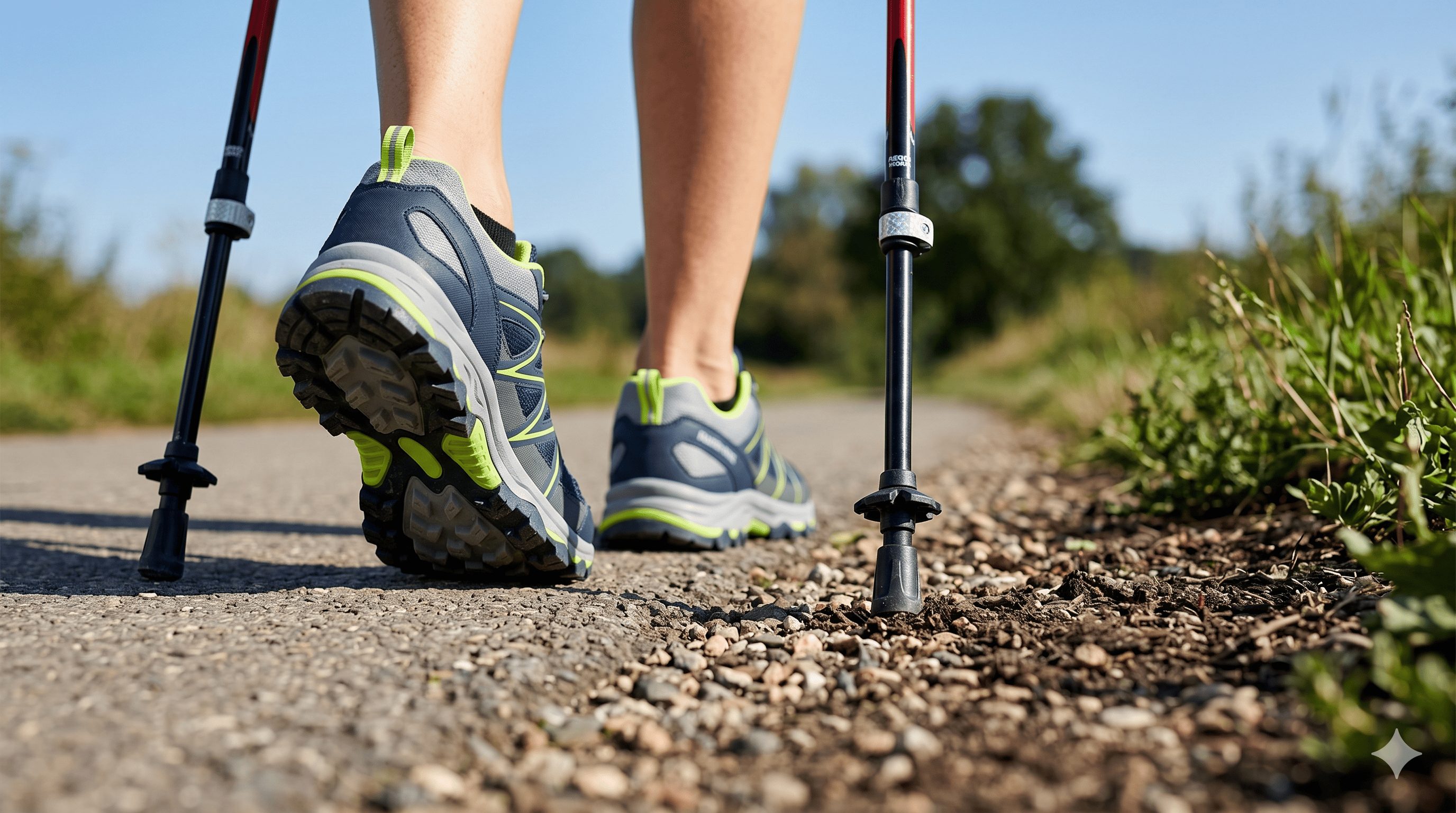
Four points of contact rather than two. On uneven ground, wet cobblestones, dirt paths, or muddy sections, poles transform stability. The risk of a twisted ankle or slipping drops significantly.
This is particularly useful for long outings, changing conditions, or simply when walking fast and wanting to remain fluid.
4. A naturally improved posture
Properly adjusted poles = straight back, eyes forward, open shoulders. The action of planting the poles encourages a rhythmic cadence and an active posture — the exact opposite of the "hunched back, eyes to the ground" look that insidiously sets in over long distances.
After a few outings with poles, many walkers notice they carry themselves better even without them.
5. Caloric expenditure increases
Arm movement is not neutral. Using Nordic walking poles (with the complete technique) increases energy expenditure by 20% to 46% compared to classic walking, according to studies. Even in "classic walking with poles," the engagement of the upper body adds value to every session.
Who is it really for?
- Beginners: poles provide security and allow you to go further from your very first outings
- Regular walkers: they protect joints over the long term and improve endurance
- Streakers: going out every day requires taking care of your body — poles are a tool for active recovery as much as performance
- Over 50s: balance and joint protection become priorities, poles deliver on both
The right adjustment in 10 seconds
Elbow at 90°, arm alongside the body: this is the ideal height for walking on flat terrain. On uphills, shorten slightly. On downhills, lengthen.
If you adjust nothing else, adjust this.
Conclusion
Walking poles are not just for mountain hikers or competitive Nordic walkers. They are daily performance tools — discreet, effective, and accessible to all levels.
Whether you walk 3 km or 30 km, they help you go further, more comfortably, and last over time.
And to build a regular habit, that is exactly what we need.
At WSWA, we walk every day. With or without poles, what matters is getting out there — but you might as well stack all the odds in your favor.
A few options if you want to fine-tune: integrate a direct mention of the Marche de la Bièvre (recent 52 km), add a "how to choose your poles" appendix, or adapt the final CTA to prompt downloading the app. Do you want us to rework a specific angle?